Case study · By Ewan Wills, freelance product designer · UK · Last updated
Bolt pick & place.
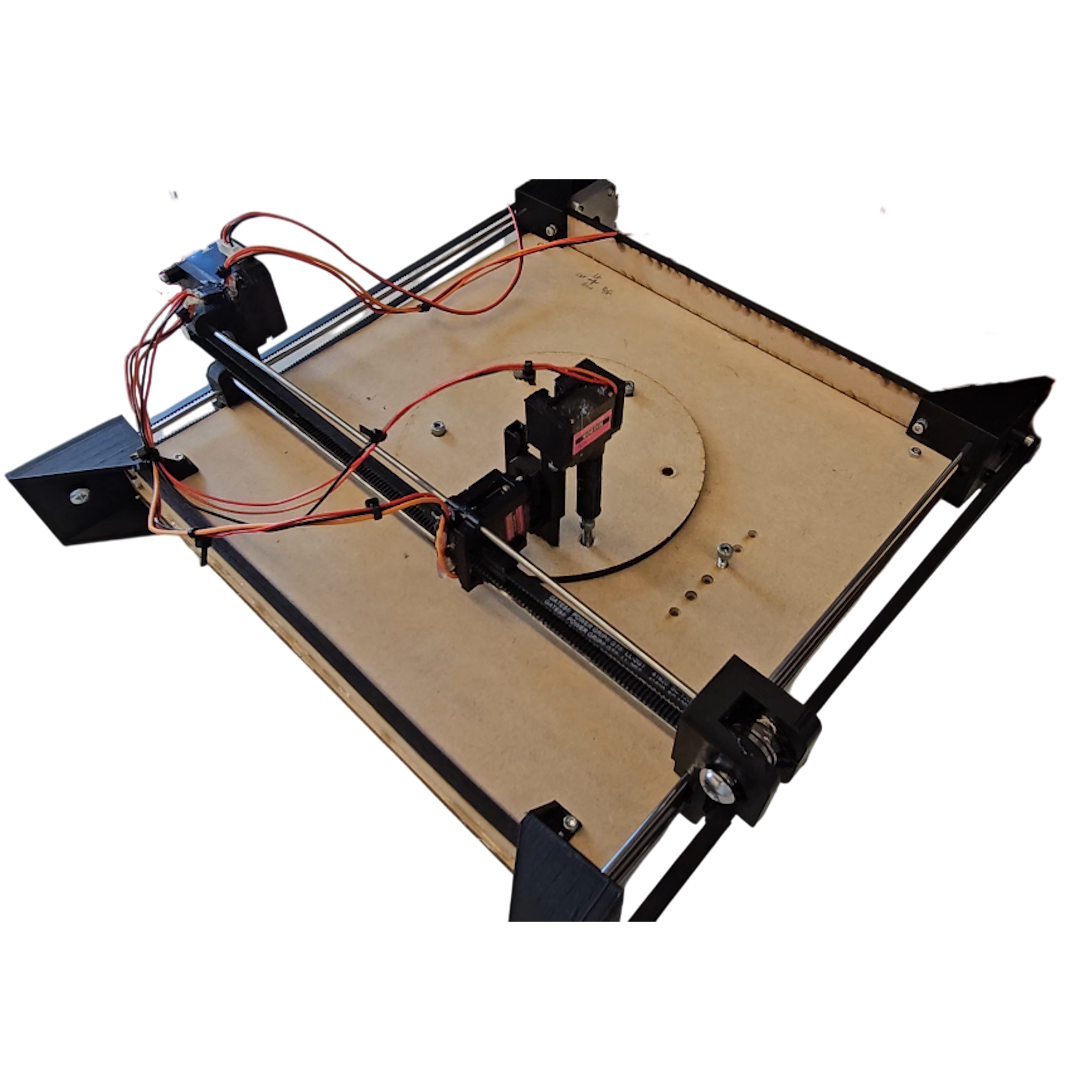
A machine that bolts two components together on its own. A Cartesian gantry handles X and Y, and a rack-and-pinion-driven Z-axis does the pick and the place. I built it for repeatability and throughput, and kept it mechanically simple on purpose.
What was the goal?
Why this architecture?
Cartesian over articulated
Over a fixed rectangular workspace a gantry is the simpler machine, and the cheaper and more repeatable one: fewer joints, so fewer places for positioning error to come from. The cost is that it only ever works over that rectangle.
Rack-and-pinion Z
Rack and pinion gives the Z-axis a long stroke and a fast one, with the same tooth engagement all the way down. That suits a cycle whose whole job is going up and down.
Simplicity as a spec
Simplicity was written down as a requirement alongside the others, rather than being whatever survived the interesting decisions. Every part I didn't add is one nobody has to make, align or maintain. Same DFM thinking as the MiniCapper.
Quick answers.
- What does the bolt pick-and-place system do?
- It bolts two components together without an operator. A Cartesian gantry puts the tool head where it needs to be in X and Y, and a rack-and-pinion-driven Z-axis performs the pick and the place. I designed it for repeatability and throughput, with mechanical simplicity as a requirement rather than an afterthought.
- Why a Cartesian gantry rather than a robot arm?
- For repetitive assembly over a fixed rectangular workspace, a Cartesian gantry is the mechanically simpler machine, and the cheaper and more repeatable one, because fewer joints means fewer sources of positioning error and less maintenance. Simplicity was a design goal here, and an arm would have bought reach this job had no use for.
- Who designs automated assembly systems like this in the UK?
- I do. I'm Ewan Wills, a freelance product designer in the UK working on robotics and automation: motion systems and gantries, plus the controls that drive them. It runs end to end, from concept and prototype through design for manufacture to supplier handoff.
More automation work.
Same bench, different machines. The MiniCapper lab-automation device puts this sort of motion inside a benchtop instrument, and the DIY CNC milling machine for aluminium is the one with a cutter on the end. The in-ear vital sign monitor is electronics rather than motion. All Ewan Wills, a UK product design studio.