Case study · By Ewan Wills, product designer · UK · Last updated
MiniCapper.
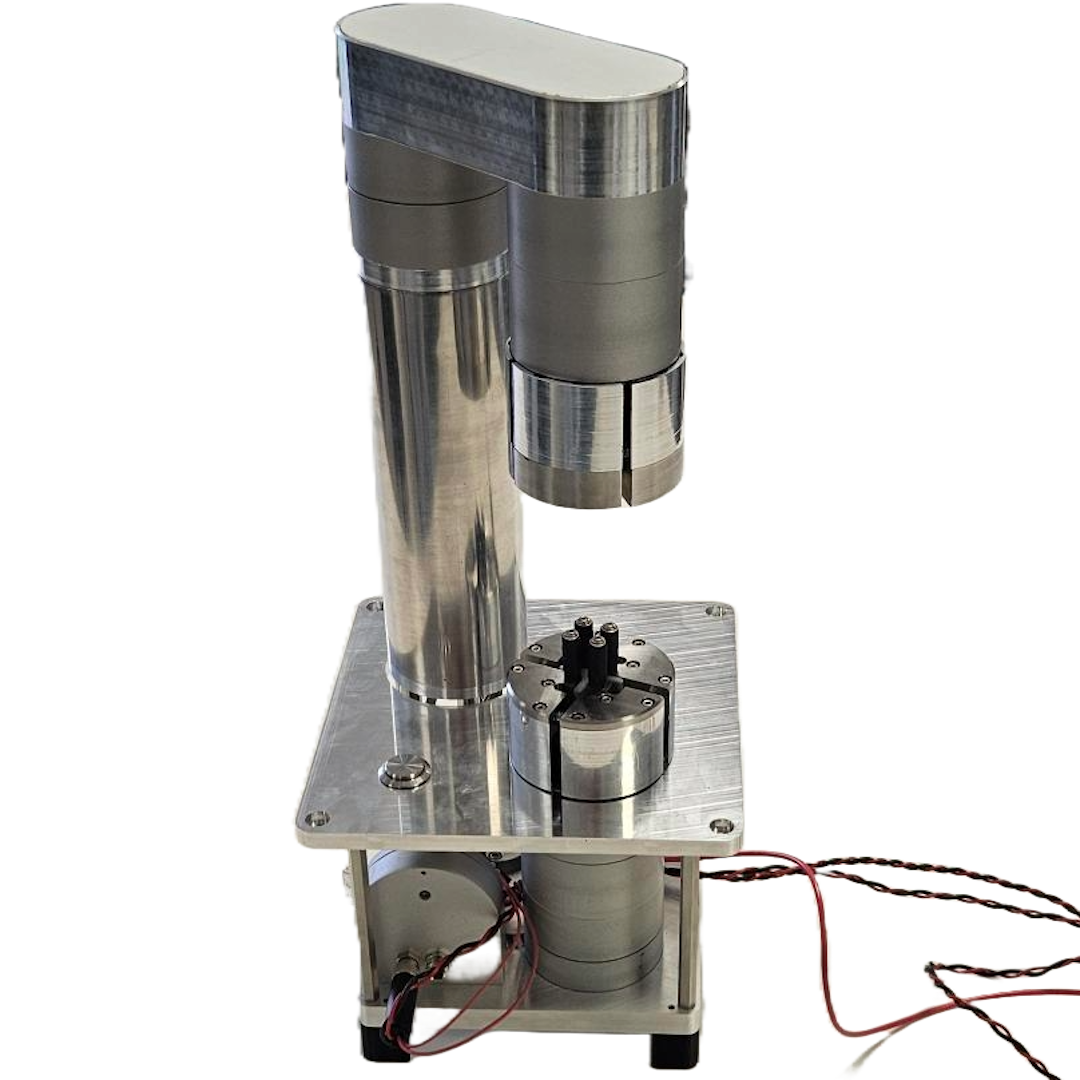
A compact module that caps and decaps vials for laboratory automation, with the pneumatics designed out. All-electric means the machine around it carries less: no air supply, no valve manifold, and capping torque set in software instead of by a mechanical stop.
I did this during an industrial placement with a UK laboratory-automation manufacturer. The design and its test data are the client's IP, so what follows is the engineering problems and how I solved them. That part travels. The drawings don't.
What was the brief?
Design a capping module small enough to go inside existing benchtop instruments rather than sit beside them, solid enough that the next engineer reuses it instead of redesigning it, and all-electric, so a machine doesn't need compressed air just to turn a cap.
Three prototypes before I cut any metal.
I scored two architectures against a weighted decision matrix before building anything. Not to find the clever one: to get the trade-offs written down while they were still cheap to change. Each prototype after that existed to fail in a particular way. The first asked whether the architecture worked at all. The second was there to shake out the CAD and the assembly, and the third to fix what the second had exposed. Parts only got machined after that.
Does it work?
Proved the architecture, and immediately showed up a flaw of its own. The sort you only find in hardware, never in CAD.
What did I miss?
Eleven distinct problems logged in one build, from fasteners nobody could reach to grippers that didn't fail closed.
Fix and prove
Friction traced and removed, mass taken out of the moving parts, serviceability designed in before I committed to metal.
Machined build
Formal design review, ISO fits specified for every bearing seat and locating feature, then built and put on soak test.
Six problems, and what fixed them.
Gripping glass without marking it
A knurled steel finger bites into a plastic cap beautifully. On glass it's ruinous. The vials carry printed barcodes, and one scratch makes a vial unreadable to every machine downstream. So I stopped treating the two grippers as the same problem: hard knurled steel on the cap, and on the vial a rigid body carrying a soft compliant surface. That took several finger geometries to arrive at, and most of the earlier ones failed.
Compliance in the wrong place
I built the first soft-gripping fingers on threaded standoffs. They gripped. Under load they also bent outward, and a vial held off-axis spins off-axis, which makes threading a cap onto it unreliable. The fix was to stop asking a threaded joint to locate anything: a toleranced shaft and hole beneath the thread took over location, leaving the thread to clamp and nothing else.
Over-constraining a lead screw
Constraining the lead screw at both ends looked like the rigid, obvious choice. In hardware it turned every tolerance stack-up and small misalignment into a tight spot mid-travel, where the axis wanted far more torque than it should have. I freed one end and let the screw find its own line. On a real assembly, over-constraint doesn't buy you rigidity, it buys you the accumulated error of every part in the chain.
Chasing parasitic friction
The drive motor ran hot and drew more current than the maths said it should. What found the causes was taking it apart, not simulating it. Three of them, stacked on each other: a fastener stack-up with no tolerance left in it, preloading the assembly; belt tension pulling the shaft laterally; and two components quietly rubbing, which had left black dust and a worn ring in the paint. Each needed its own fix. "More friction than expected" is rarely one thing.
The fix that testing deleted
Backlash in one joint meant the arm couldn't place itself perfectly by encoder count alone, so I designed and built two adjustable mechanical stops to correct for it, and trialled them. Testing then showed the mechanism already corrects itself: closing a four-jaw gripper over the vial pulls it concentric wherever the arm happened to stop. Both stops were deleted. I'd spent the budget before anyone measured the problem.
Designing for the person who builds the next one
A module only gets reused if other engineers trust it, and they won't if it's miserable to assemble. The second prototype couldn't be built at all without one specific sequence, and some fasteners were unreachable once the neighbouring parts went on. Several engineers also pushed back on one mechanism purely on how it looked and felt. I took that seriously: on an internal component, that reluctance is what stops it getting used. Access, assembly order and serviceability ended up as constraints in their own right, and I changed the grippers to fail closed so a power cut doesn't drop a vial.
How I proved it.
Every requirement had a verification method attached to it before design started, which is what stops "solid enough" and "compact" turning into opinions later. In practice that meant building rigs. One measured how hard people actually do up a vial by hand, so the drive could be sized against what people do rather than against a guess. Others found the minimum gripping force that still holds, and characterised the axis across several drivetrain options, so the next engineer picks from measured data instead of starting again. I also trialled a flat flexible cable in place of a cable chain, with its per-core resistance logged periodically through the soak test, to prove the cheaper and simpler option before adopting it. Final validation was a long soak test across the full range of consumables.
One test produced no usable correlation at all. It met its objectives (the number it existed to find, it found) but the relationship I was hoping to see wasn't in the data, because I'd left too many variables in play at once. I'd design that one differently.
What I'd carry to the next one.
Test the risks you predicted
A failure mode I predicted justified a whole sub-assembly, and testing then made it redundant. Run the cheap experiment before you pay for the elaborate insurance.
Standardisation has a price
Where one component decides the headline performance figure, reaching for the standard part is a decision rather than a default, and the cost of it belongs in writing.
Spend on the detail that repeats
Hours spent simplifying assembly and machining are a bad deal on build one and a good one by build ten. Which of those you're in depends entirely on how often the design gets reused.
Software is always underestimated
Even a simple control routine ate far more time than its complexity suggested. Integration and the things nobody saw coming are where the hours went.
Quick answers.
- What is the MiniCapper?
- MiniCapper is a compact module that caps and decaps vials for laboratory automation. It is all-electric, servo-driven rather than pneumatic, so a system using it needs no compressed air supply just to turn a cap, and capping torque can be controlled in software rather than set by a mechanical stop.
- What was Ewan Wills's role?
- Mechanical design, design for manufacture, build and test validation. I did it during an industrial placement with a UK laboratory-automation manufacturer, and the work ran from concept selection through three prototype iterations to a machined-metal build and the test programme that validated it.
- Why does this case study not include drawings or performance figures?
- The design, its drawings and its test data are the client's intellectual property and are not published here. What this case study covers is the engineering problems I ran into and how I reasoned about them, which is the part that transfers to another project.
More robotics product design.
MiniCapper is the lab-automation one. Elsewhere on the site: the automated bolt pick-and-place, a DIY CNC milling machine for aluminium and the in-ear vital sign monitor. All Ewan Wills, a UK product design studio taking hardware from concept to manufacture.